Industrial odor control has traditionally been addressed using wet scrubbers, biofilters, activated carbon filters, chemicals, or high-temperature systems (thermal oxidation or RTOs). In some situations, these methods work well. But in today’s industrial environments, they do not always offer the flexibility, efficiency, or simplicity that companies need.
That is why more and more companies are opting for cold plasma injection technology as an alternative approach to odor control. But how exactly does it work?
In this article, we explain how cold plasma technology works for odor control, why it is effective in industrial settings, and when it might be the right solution.
What is cold plasma injection technology?
To understand how cold plasma technology works, it’s helpful to start with the basics.
Plasma is often described as an energized state of matter. In odor control, it is created by applying electrical energy to air or gas. This generates highly reactive components, such as radicals, ions, and other reactive particles.
These reactive particles are important because they don’t simply trap odor molecules; they help break them down at the molecular level.
That is the main difference between cold plasma and many traditional odor control methods. Instead of masking odors or transferring them to another medium, cold plasma technology helps neutralize odor-causing compounds at the molecular level.
How does cold plasma technology work for odor control?
Cold plasma technology reduces odors by breaking down odor molecules before they leave the process air stream. Instead of masking odors or trapping them in a filter, it transforms the odor-causing compounds through oxidation.
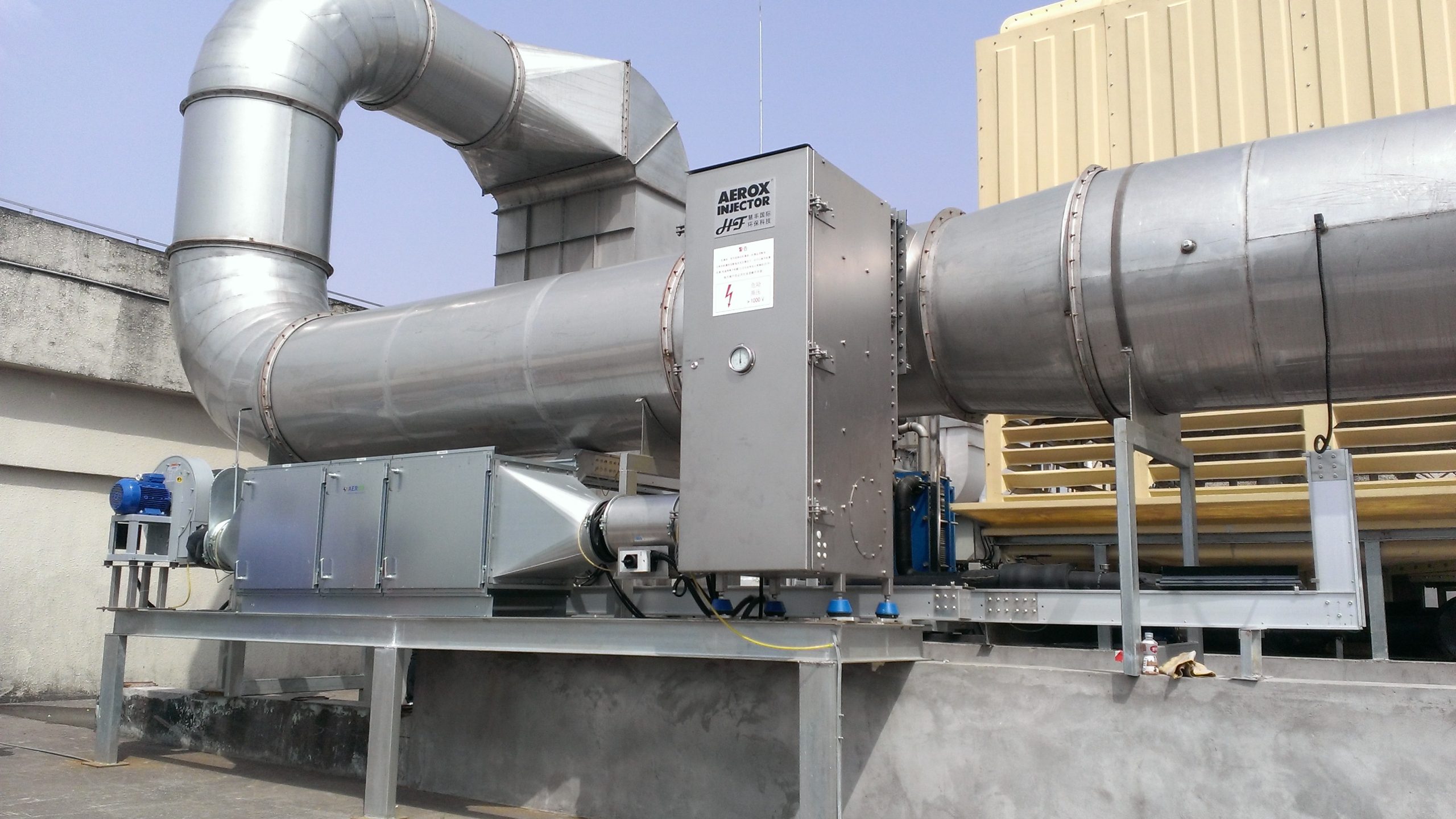
Aerox’s technology achieves this using plasma cells based on DBD (Dielectric Barrier Discharge). Put simply, an electrical discharge generates reactive components from filtered and conditioned air.
This process consists of five steps.
Step 1: A small stream of ambient air is drawn into the system
The Aerox Injector does not treat the entire process air volume directly. Instead, a small external air stream is drawn in. This air is first purified using HEPA filtration and then conditioned before entering the plasma cells. This is important because it keeps the system compact and contributes to a stable process.
Step 2: The air passes through the plasma cells
Within the system, the conditioned air flows through the plasma cells. These cells utilize electrical discharges between insulated electrodes. This DBD process activates the oxygen and water vapor present in the air. In this phase, ordinary air is converted into a reactive mixture.
Step 3: Reactive particles are formed
When the air is energized, highly reactive and short-lived compounds are formed, including oxygen and hydroxyl radicals. These reactive particles are essential because they do the actual work of breaking down odor molecules.
Step 4: The reactive gas is injected into the process air
The reactive air mixture is then injected at high speed into the odor-emitting process stream or exhaust duct. Because the system uses injection rather than full-flow treatment, it can often be integrated into existing ducts or chimneys without major modifications.
This makes the technology practical for industrial companies where space and downtime are limited.
Step 5: The odor molecules are oxidized
As soon as the reactive particles come into contact with odor compounds, a rapid oxidation reaction takes place. This alters the chemical structure of the odor molecules. As a result, the odor is reduced or is no longer detectable by the human nose.
Why does this work well in industrial environments?
Industrial odor control isn’t always easy. Most companies face a combination of challenges: mixed odor streams, fluctuating air volumes, and changing production conditions. What works in a stable laboratory environment doesn’t always perform the same way in a real factory.
That’s where cold plasma injection technology comes into play.
It processes complex and fluctuating odor streams
In many industrial processes, odor is not caused by a single compound. It is the result of a constantly changing mixture of substances, influenced by raw materials, temperature, and production stages.
Because cold plasma works through reactive decomposition at the molecular level, it does not rely on a single specific reaction. Instead, it can interact with a wide range of odor-causing compounds. This makes it more suitable for situations where the odor profile changes over time, rather than remaining constant.
It performs well under varying conditions
Industrial environments are rarely static. Airflow can fluctuate throughout the day, production may occur in batches, and the load may increase during certain shifts or seasons. Some odor control systems perform best under controlled and predictable conditions. When those conditions change, performance may decline.
Cold plasma is better suited for these variations because its effectiveness is not limited to a single fixed set of operating parameters. Furthermore, the cold plasma output can be easily and continuously adjusted, ensuring optimal odor control with the lowest energy consumption.
It reduces dependence on strict process conditions
Many traditional odor control technologies are highly dependent on specific conditions:
- Activated carbon filters become saturated as the load increases.
- Biofilters depend on stable humidity, temperature, and biological activity.
- Chemical scrubbers require continuous dosing, monitoring, and wastewater treatment.
- Thermal oxidation consumes a lot of energy; in addition, NOx emissions can become a major problem.
If these conditions are not maintained, performance becomes less predictable. Cold plasma reduces that dependence. It works through oxidation driven by reactive particles, rather than through biological processes, chemical dosing, or physical capture alone.
It reduces operational complexity
In industrial settings, performance is only part of the story. A system must also be practical to use. Traditional solutions can introduce additional layers of complexity, such as chemical logistics, biological stability, or high energy requirements.
Cold plasma offers a different approach. By relying on electrical energy to generate reactive particles, it avoids the use of large quantities of chemicals, reduces waste streams, and eliminates the need for high-temperature processes. This often results in a system that is easier to integrate and manage over time.
What are the main advantages of cold plasma technology?
No use of chemicals
Cold plasma systems do not rely on chemical dosing to neutralize odors. This reduces the need to store, handle, and replace chemicals. It also eliminates the wastewater streams associated with some other treatment methods.
Lower energy consumption
Compared to high-temperature systems such as thermal oxidation, cold plasma generally requires less energy. This can help reduce operating costs, especially in facilities where odor treatment must run continuously.
Compact System Design
Industrial companies do not always have room for large treatment systems. Cold plasma systems can often be integrated into existing environments without the large space requirements of some alternative technologies.
This makes the technology practical for retrofits, upgrades, and companies with limited installation space.
Low maintenance requirements
Because the technology does not rely on replaceable filter media, biological beds, or continuous chemical management, maintenance can often be kept to a minimum. This makes it an attractive option for companies where uptime, reliability, and simplicity are important.
Suitable for continuous operation
Cold plasma can be used in industrial processes where odor control must operate consistently and reliably over long periods of time. This makes it a good option for companies that cannot afford frequent interruptions or complex interventions.
When is cold plasma the right solution?
Like any technology, cold plasma technology is not automatically the right solution for every situation. Its value depends on the process, the odor profile, and the operational context.
However, cold plasma is often a good choice when:
- odor streams contain mixed or varying compounds.
- air volumes are high or variable.
- the installation space is limited.
- low-maintenance operation is important.
- chemical-free odor control is preferred.
- Sustainability goals influence the choice of technology.
In situations where processes are complex and conditions are not always stable, cold plasma can offer a more flexible and efficient approach.
Conclusion
Cold plasma technology works by using electrical energy to generate reactive particles. These reactive particles break down odor-causing molecules through oxidation. Instead of masking odors, trapping them in filters, or destroying them with high temperatures, cold plasma neutralizes odor compounds at the molecular level.
This makes it particularly well-suited for industrial environments where odor patterns are complex, conditions change over time, and operational efficiency is important. For companies looking for effective odor control without unnecessary chemicals, large-scale systems, or high energy consumption, cold plasma technology offers a flexible and forward-looking solution.
Looking for a solution that fits your process?
At Aerox, we specialize in the application of cold plasma technology in industrial settings using our Aerox Injector.
With 30 years of experience in odor control, we help companies navigate complex odor challenges and find solutions that work in practice—whether they involve mixed odor streams, changing conditions, or strict regulations. Our focus remains the same: effective odor reduction with minimal operational impact.
Want to explore what we can do for your business? Feel free to get in touch.